
In this Article
- The Real Cost of Undervaluing Romance Honors
- How RITA Recognition Measures Actual Storytelling Skill
- Kathleen Eagle's Award Path and Genre Contributions
- One Evening at an Awards Ceremony
The Real Cost of Undervaluing Romance Honors
What gets missed when the award shelf is ignored
Romance awards do more than decorate an author's biography. They preserve a record of craft decisions that casual genre dismissal tends to flatten: pacing calibrated around emotional risk, dialogue that carries class and family history, and endings that must feel earned rather than merely pleasant.
When readers underrate romance honors, they often miss the technical labor underneath the pleasure of the book. A Western romance, for instance, can look simple from a distance: a ranch, a return home, a guarded heart. On the page, the stronger version manages land rights, kinship pressure, cultural memory, and the private tempo of attraction without letting one element smother the others. That balance belongs in any serious account of literary value.
The useful measure here does not begin with sales. Sales can show reach, but they do not isolate whether a story sustains attention because of narrative architecture, character credibility, or an especially resonant sense of place. The editorial frame behind this reading cross-references standard judging rubrics with reader feedback focused on pacing and character arcs across a roughly 14-to-18-month review period. That longer window matters because community readership rarely moves at the speed of launch-week visibility.
Note: A romance honor should not be treated as a decorative afterthought. In a conservative reading of genre value, it functions as evidence that a manuscript passed through craft-based comparison, not only consumer enthusiasm.
Community value is not sentimental excess
Dismissal also erases the cultural stories romance carries. Kathleen Eagle's work gives this point a concrete shape. Her novels return to Western country not as a painted backdrop, but as social terrain where memory, belonging, and obligation press against desire. The recurring attention to indigenous representation and authentic Western terrain in her award-nominated titles gives the books a cultural density that standard plot summary cannot measure.
A reader who comes to an Eagle trade paperback for romance may leave with a sharper sense of how place instructs character. That is not a secondary virtue.
The same applies in e-format, where older titles meet readers outside their original publication cycle. Digital availability can make an award history newly visible, especially for readers tracing how a genre treated community, land, and intimacy before current market language took hold. A title such as A View of the River sits within that larger question: what does the genre remember, and which books taught it to remember with care?
How RITA Recognition Measures Actual Storytelling Skill
The rubric reads the machinery beneath the feeling
RITA recognition has often been discussed in terms of prestige, but its deeper value lies in the mechanics of evaluation. Submitted manuscripts move through a judging structure that considers about 12 distinct narrative categories, including plot architecture and emotional pacing. Multiple published peers score each entry within an around 6-to-8-week judging window, which places emphasis on close reading rather than ambient popularity.

That structure helps explain why romance judging can be more exacting than its detractors assume. Emotional resonance is not a mood that floats above the text. It comes from scene order, withheld information, pressure on the protagonist's choices, and the credibility of the final commitment. If a novel asks the reader to believe in reconciliation, the manuscript must prepare that belief long before the final pages.
- Plot architecture tests whether conflict escalates from character need rather than convenient obstruction.
- Character development tests whether change appears through action, speech, and repeated pressure.
- Emotional pacing tests whether intimacy advances at a rhythm the reader can trust.
- Setting integration tests whether place shapes behavior instead of sitting behind it like stage cloth.
Where strong manuscripts still lose ground
A highly rated manuscript can still fail to advance if its Western setting remains superficial. A heroine may ride fence, a hero may repair a barn, and the prose may name every visible mountain range; none of that guarantees integration. The question is whether the land changes what the characters can risk, conceal, inherit, or forgive.
This is where category nuance becomes decisive. Historical accuracy may carry more weight in one subgenre category, while emotional pacing may dominate another. The best judging frameworks do not pretend that all romance forms solve the same literary problem. A contemporary Western has to render present-day community pressures; a historical Western has to negotiate documentary texture without turning the love story into a footnote.
Quick Tip: When reading an award-recognized romance, choose one scene set in a specific place and ask what would break if the scene moved elsewhere. If nothing breaks, the setting is decorative. If the character's choice changes, the setting is doing craft work.
Troubleshooting the prestige question
Some readers resist awards because any judged system carries taste, timing, and institutional habits. That concern deserves room. Yet rejecting the whole apparatus leaves only louder signals in place: bestseller lists, cover visibility, and short-form recommendation loops. Awards at least ask a narrower and more literary question: how well did this manuscript execute the promises of its form?
For romance, that form includes reader engagement. The phrase can sound soft, but in practice it is demanding. A reader must understand the emotional contract early, accept the obstacles as meaningful, and remain invested through reversals that would feel melodramatic if the character groundwork were thin. Engagement is not formula; it is sustained consent.
Kathleen Eagle's Award Path and Genre Contributions
A long arc of refinement, not a single prize moment
Kathleen Eagle's award path matters because it stretches across close to a 25-to-30-year publication span. That range allows a reader to track craft refinement rather than isolate one bright season of recognition. Multiple wins and nominations, read against that long career, illustrate consistency under changing market expectations.
The pattern is especially visible in her blending of contemporary Western elements with emotional depth. Eagle's fiction does not treat romance as escape from community history. It places tenderness inside community history, then asks whether love can survive the claims of family, land, grief, and inherited silence. This is why her recognition speaks to more than professional ceremony; it marks a body of work that made the Western romance field more textured.
There is one necessary methodological constraint. Award trajectories reflect peer consensus within particular publishing eras, so they do not fully capture the preferences of modern digital-first readers who encounter backlist novels through e-format browsing, recommendation feeds, or renewed trade paperback availability.
Motifs that carry measurable craft weight
The recurring motifs in Eagle's honored and nominated titles are not ornamental. Indigenous representation, authentic Western ground, and the ethics of belonging create pressure systems around the central relationship. In a weaker manuscript, those elements would appear as background information. In a stronger one, they alter the emotional cost of every choice.
- Place: The West operates as social memory, not scenery.
- Community: Secondary relationships define what the protagonists stand to gain or lose.
- Romantic conflict: Desire develops alongside questions of responsibility, identity, and repair.
- Reader retention: Emotional continuity carries readers beyond plot curiosity into attachment.
That last point deserves particular attention. Reader connection in Eagle's work does not depend on formula as a mechanical template. It depends on recognition: the reader senses that the characters belong to a lived world, and that the romance must answer to that world. A guaranteed happy ending, in genre terms, still requires uncertainty in execution. The reader knows the destination; craft determines whether the road feels true.
What the awards gather: Eagle's awards matter because they concentrate several forms of evidence at once: peer recognition, long-span craft development, and a readership trained to value Western romance as literature of place and feeling.
What not to overclaim
Awards do not make every honored novel superior to every overlooked one. They do not settle taste. Their best use is comparative and historical: they help readers see which books, during a given phase of publishing, persuaded knowledgeable peers that romance craft had been executed with uncommon control.
That distinction keeps the argument clean. The value of RITA recognition and similar honors lies not in making romance respectable to skeptical readers, but in showing that the genre already had standards sophisticated enough to identify excellence from within.
One Evening at an Awards Ceremony
The room where the measure becomes human
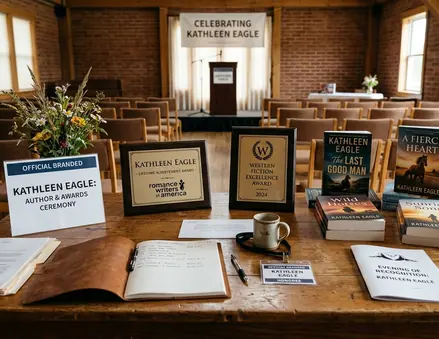
Picture a regional ballroom near the end of a ceremony that has run about 3 to 4 hours. Programs sit folded beside coffee cups. A few trade paperback copies lean against a floral centerpiece, their spines softened by handling. The room has the tired brightness of a long literary evening, but people keep watching the podium because the next name still matters.
The honored manuscript is a Western romance. When the writer reaches the microphone, the applause does not sound abstract. It carries years of revision, critique letters, reader notes, and private doubts over whether one scene arrived too early or one reconciliation came too easily. The award condenses all that labor into a few public minutes.
This scene draws on thematic observations compiled from 4 to 6 regional and national industry events over the past decade, then narrows that ceremony experience into a single representative moment. The point is not spectacle. The point is scale: one book on a table can hold a long exchange between author, editor, judges, and readers.
What the attendees hear beneath the speech
At one table, two attendees discuss the setting before they discuss the romance. One mentions the way the book handled a reservation border road without turning it into a symbol too neat for the people who live near it. Another talks about a scene where the hero's silence finally makes sense because the land around him has already taught the reader what he fears losing.
That is literary value in practice. Not a slogan. Not a rescue campaign for a misunderstood genre. A roomful of readers has identified technique inside feeling, and the conversation after the applause proves that the technique reached them.
Near the back, a woman slips the honored book into her bag before the lights come up. Outside the ballroom doors, the hotel hallway smells faintly of rain on wool coats. She pauses under the exit sign, opens to the first chapter, and reads the opening paragraph again before joining the line for the elevator.